Eastern Subterranean Termite Control
Eastern subterranean termites are the native species across North Texas. They nest in soil and build mud tubes to reach wood. Liquid soil barriers and bait stations are the main treatments.

Texas Shield Pest – Affordable Termite Control Company
Texas Shield Pest provides termite control in Keller, TX. We combine detailed inspections with proven liquid barrier and bait station methods to eliminate active colonies, protect slab foundations and wood framing, and lower the chance of termites returning to local homes and businesses.
☑ Free termite inspection, same day or next day.
☑ Renewable termite warranty with annual monitoring.
☑ Official Texas WDI reports for home sales.
20+
Awards
2.8K
Satisfied customers
A termite exterminator should find the colony's path into your home, not just treat damaged wood. In Keller, termites often travel up through slab cracks, plumbing gaps, and expansion joints. Our inspections trace those routes first, then match the treatment to the species and the house. Book your free termite inspection to see exactly where they are getting in.
Call Now (689) 000-0000Keller homes can face more than one kind of subterranean termite, and each calls for a different plan.
Eastern subterranean termites are the native species across North Texas. They nest in soil and build mud tubes to reach wood. Liquid soil barriers and bait stations are the main treatments.
Formosan termites have been detected in Tarrant County. Their colonies grow much larger than native ones and can nest above ground, so whole-colony bait systems are often used.
Winged swarmers indoors mean a mature colony is nearby. Vacuuming them up helps, but the real work is tracing where they emerged and treating the colony behind them.
Local conditions give termites easy access to Keller homes, often with no visible sign until damage appears.
Texas A&M's urban entomology program lists Tarrant County among the counties where Formosan termites have been detected. That does not mean every Keller neighborhood has them, but inspections should check for them.
Expansive clay soil swells when wet and shrinks in drought, which can crack slab foundations. Subterranean termites can pass through a crack thinner than a credit card into wall framing. Ants use those same foundation cracks to get inside, and our trusted ant control for Keller homes treats and seals them.
Recycled railroad ties are thought to be the main way Formosan termites spread in Texas. Old ties, landscape timbers, and deep mulch beds against the slab give termites food and cover.
Formosan termites call for careful identification and the right products, which starts with proper licensing.
Termite work in Texas requires a license, and ours comes from the Texas Department of Agriculture in its Termite and Wood Destroying Insect Control category. We apply only EPA-registered termiticides, and you can verify any company's license with the Structural Pest Control Service.
We never assume a termite is Formosan or native. Instead, we collect soldiers or swarmers and look for carton material. The answer shapes the plan: native colonies often respond to a soil barrier, while Formosan colonies with above-ground nests usually need bait too.
Termites stay hidden, so most homeowners spot the evidence before they ever see the insects. Watch for:
Here is what every termite customer gets from us, from the first inspection through yearly checks.
Found swarmers or fresh mud tubes? We offer same-day and next-day termite inspections, so you can learn whether the colony is active and how far it reaches.
Termite work in Texas falls under the Texas Department of Agriculture's Structural Pest Control Service, which licenses our business. Every termiticide we apply is EPA-registered and used according to label directions.
If new mud tubes or swarmers appear after treatment, our free re-service guarantee covers a return visit to retreat the affected area at no extra charge.
Once a year, we check bait stations, monitoring devices, and the foundation line, so new termite activity gets caught before it reaches the wood framing.
Each service below fits a different situation, from a home sale to a new slab.
We check the slab edge, garage, attic, plumbing gaps, and exterior wood for mud tubes and damage. Every termite plan starts with this free inspection.
A wood-destroying insect (WDI) report documents any termite activity or damage found during a sale inspection. We complete the WDI inspection in Keller and explain any findings before closing.
A non-repellent liquid termiticide is applied to the soil around the foundation. Termites do not sense it, so they forage through it and spread it to others in the colony.
Stations are set into the soil at spaced intervals around the home. Once termites start feeding on the monitoring wood, slow-acting bait replaces it, and workers share it through the colony.
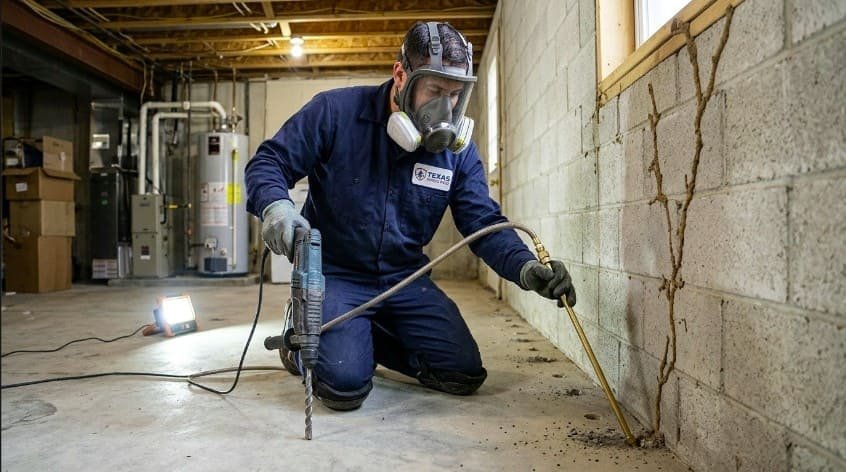
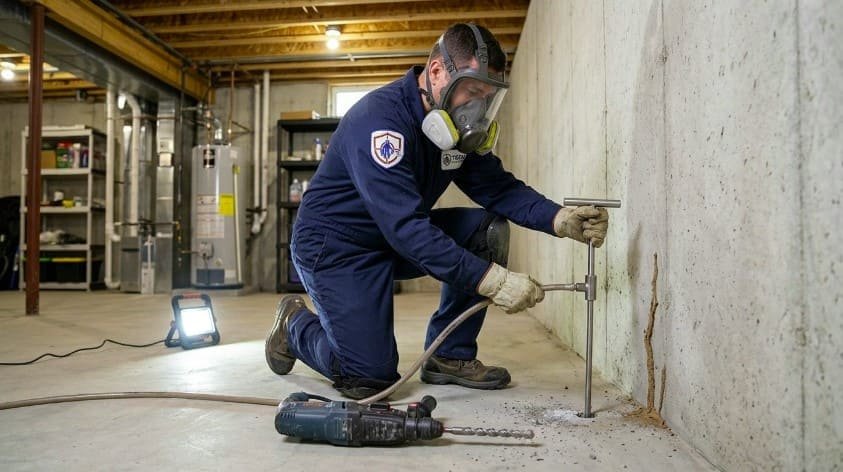
Slab homes often need treatment at hidden entry points, such as plumbing penetrations, bath traps, and expansion joints. This can involve drilling through the slab to place termiticide below.
Before a slab is poured, we treat the soil so a termite barrier sits beneath the foundation. Builders and owners planning an addition can schedule it before framing starts.
Every termite job follows the same order, from finding the problem to keeping it from returning.
We walk the full property, inside and out, marking every mud tube, damaged board, and moisture problem on a simple diagram so you can see where termites are active.
Native subterranean termites and Formosan termites need different strategies. Swarmer timing, soldier head shape, and nest type help confirm which species is present before treatment begins.
Based on the species and the home's construction, we use a liquid barrier, bait stations, or both. Treatment focuses on active areas and the full foundation perimeter.
After treatment, monitoring devices stay in place to show new activity early. Keeping mulch pulled back from the slab and fixing leaky outdoor faucets also reduces the moisture termites look for.
We provide termite control throughout Keller, including Hidden Lakes, Marshall Ridge, Bear Creek, Overton Ridge, Highland Oaks, and Old Town Keller. Our service also reaches Southlake, Colleyville, North Richland Hills, Haltom City, Saginaw, Lake Worth, Benbrook, Mansfield, Burleson, and Weatherford. Every property gets the same full inspection before treatment is chosen.
Native subterranean termites swarm during the day, mostly in spring and often after rain. Formosan termites swarm at night in late spring and gather around lights.
Yes, Formosan termites have been detected in Tarrant County, though that does not mean they are in every neighborhood. Old railroad ties in your yard are worth checking.
Plan on a professional termite inspection every year. Get one sooner if you notice swarmers, mud tubes, or new moisture problems around the foundation.
It is not always required by law, but buyers and lenders often request one during a sale. Ordering it early helps avoid delays if the inspection finds termite activity.
Mud tubes, swarmers, or soft wood are worth checking before damage spreads. A free inspection shows whether termites are active, which species you have, and whether a liquid barrier, bait stations, or both fit your home. Same-day and next-day appointments are available. Call us today to schedule your visit and get a clear plan for termite control in Keller, TX.
Termites are not the only pests around Keller homes. We also handle rodent, ant, mosquito, scorpion, and cockroach control for residential and commercial properties. Fire ant mounds that pop up after rain and striped bark scorpions hiding in attics are two problems these services cover. Each pest gets its own plan, so ask about any of them during your termite inspection. For everything else, explore our fast pest control across Keller and nearby cities.